I arrived in Prague expecting beauty.
The city did not disappoint.
The architecture is stunning. The cobblestone streets seem to whisper stories from centuries past. Everywhere I turned, I found myself stopping to admire church spires, historic buildings, and views that looked like they belonged on a postcard.
But it wasn’t the beauty of Prague that will stay with me.
It was the names.
The night before touring Prague’s Jewish Quarter, I met a college professor from North Carolina named Gabe. As we talked, I learned that he specializes in Holocaust studies.
I was intrigued.
Knowing I would be visiting the Jewish Quarter the following day, I asked him some questions that had puzzled me for years.
How does someone come to hate an entire group of people?
How does hatred become powerful enough to influence an entire nation?
How does something as horrific as the Holocaust happen?
Gabe explained that hatred rarely begins with violence. It begins with stories. It begins with fear. It begins with people identifying someone else as the cause of their problems.
He talked about how antisemitism had existed in Europe long before Hitler. Hitler did not invent it. He exploited it. He amplified it. He used it to unite people around a common enemy.
As we talked, I found myself wondering whether history is really as distant as we like to believe.
Or whether the seeds of division still exist whenever we stop seeing one another as fully human, and believe the stories we hear versus actualizing truth.
At the end of our conversation, I asked him one final question.
How did the Jewish people recover?
His answer was immediate.
“They never recovered.”
The simplicity of his response stopped me in my tracks.
The next morning, I understood why.
Walking through Prague’s Jewish Quarter was unlike any experience I have ever had.
The Old Jewish Cemetery alone is difficult to comprehend. For centuries, Jews were prohibited from burying their dead outside the designated Jewish area. As the community grew and space became limited, graves were layered upon one another. Today, thousands of headstones stand crowded together, leaning in every direction, as though history itself is struggling to find enough room.
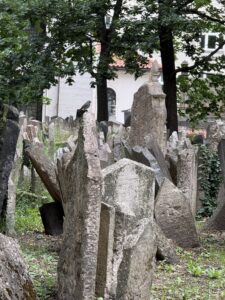
It is humbling.
It is sacred.
And it is impossible not to feel the weight of the lives represented there.
But nothing prepared me for the Pinkas Synagogue.
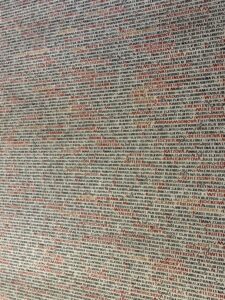
The synagogue serves as a memorial to the Jewish victims of the Holocaust from Bohemia and Moravia. Covering the walls are names.
Thousands upon thousands of names.
Not numbers.
Not statistics.
Names.
Each one carefully inscribed.
Each one representing a human life.
As I stood there, I found myself moving slowly from wall to wall. Reading. Pausing. Taking it in.
A name.
Another name.
And another.
Children.
Parents.
Grandparents.
Entire families.
Lives interrupted.
Dreams extinguished.
Future generations were erased before they ever had the chance to exist.
Like many people, I have heard the number six million countless times throughout my life.
Six million Jewish lives lost.
It is a number almost too large for the human mind to grasp.
But standing in that room, something shifted for me.
The names transformed the statistic into something personal.
Six million was no longer a number.
It became millions of individual stories.
We watched video of young people skiing, laughing, and enjoying each other just days before the horrors of the Holocaust began.
Millions of people who laughed, loved, prayed, worried, celebrated birthdays, raised children, pursued dreams, and contributed to their communities.
People who mattered.
As I reflected on Gabe’s words from the night before, I finally understood what he meant.
You do not recover from the loss of six million people.
You do not recover entire family trees that disappeared.
You do not recover generations that were never born.
You do not recover the artists, teachers, scientists, mothers, fathers, and children whose lives were stolen.
The Jewish people have shown extraordinary resilience. Jewish communities continue to thrive around the world. Their culture, faith, traditions, and contributions endure.
But recovery is not the right word.
Some wounds become part of history forever.
Some losses leave an absence that can never be fully filled.
As I walked out of the synagogue, I found myself wrestling with a deeper question.
What allows ordinary people to participate in extraordinary cruelty?
History often portrays evil as something obvious, something committed only by monsters.
But the Holocaust reminds us that it began much earlier.
It began when people accepted narratives that divided “us” from “them.”
It began when fear became more powerful than compassion.
It began when people stopped seeing their neighbors’ humanity.
And that realization feels especially relevant today.
We live in a world increasingly divided by politics, religion, race, ideology, and identity. Every day, we are invited to sort people into categories and camps. Every day, we are encouraged to decide who belongs and who doesn’t.
The lesson I carried from Prague is not simply “never forget.”
It is remember why.
Remember what becomes possible when hatred is normalized.
Remember what happens when we fail to speak up.
Remember that every person has dignity and worth.
Remember that every name belongs to someone.
As many of you know, my work centers around second chances, compassion, courage, and human potential. Standing inside the Pinkas Synagogue reminded me that these are not abstract ideas. They are choices we make every day.
We choose whether to see one another as human.
We choose whether to lead with curiosity or judgment.
We choose whether to build bridges or walls.
Perhaps that is why the names affected me so deeply.
They were not simply names on a wall.
They were a reminder.
A reminder of what is lost when we forget that we belong to one another.
Tomorrow I travel to Berlin, where I know these reflections will continue. I suspect I will leave with more questions than answers.
But tonight, I carry those names with me.
And, I always will.