Over the past few months, I have found myself asking a question I never expected to ask.
Has the world quietly changed while we were busy living our lives?
Not just technologically. Not just politically. Fundamentally.
I’ve recently had this same conversation with CEOs, nonprofit leaders, entrepreneurs, coaches, and friends. The details are different, but the feeling is remarkably similar.
“Something feels different.”
We can’t always explain it, but we can feel it. And interesting, we all think it is us. What are we doing or not doing to make the shifts we are desiring?
Here is what I know,
The pace has accelerated. Artificial intelligence has entered nearly every conversation about work. Political division continues to shape how we relate to one another. The amount of information coming at us each day feels almost impossible to process.
Yet beneath all of that, I believe something much deeper is happening.
We’re being invited to rethink what it means to be human.
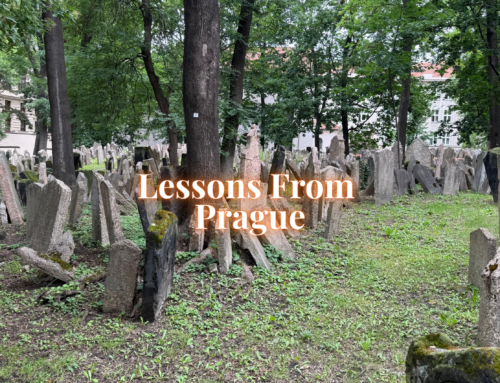
This realization didn’t come to me while sitting behind my desk. It came while walking the streets of Prague, Budapest, and Berlin. It came while standing before the remnants of the Berlin Wall. It came while reading the names of more than 77,000 Jewish victims engraved on the walls of the Pinkas Synagogue in Prague. It came while listening to conversations in languages I couldn’t understand and realizing that people everywhere are asking many of the same questions we are.
How do we belong?
How do we create meaning?
How do we live well during uncertain times?
Traveling helps me remember that history reminds us that humanity has always lived through seasons of extraordinary change. Wars. Economic upheaval. Technological revolutions. Political uncertainty. Entire societies have been forced to redefine themselves.
Perhaps this is simply our generation’s version.
When I returned home, another transition awaited me.
Boxes. Packing paper. New rooms. A new neighborhood.
Moving has a funny way of exposing what really matters. You quickly realize how much you’ve accumulated that no longer serves you. You discover that the things you treasure most usually aren’t the things that cost the most.
You begin asking yourself questions that sound surprisingly similar to the ones our world seems to be asking.
What do I keep?
What do I let go of?
What belongs in this next chapter?
Maybe that’s exactly where we are collectively.
For years, success was measured by how much information we could gather. Knowledge was power.
Today, information is everywhere.
Artificial intelligence can summarize a report, write an email, build a presentation, generate a marketing plan, and answer questions in seconds.
Knowledge is no longer scarce.
Wisdom is.
That distinction feels incredibly important.
The future doesn’t belong to the person who knows the most facts. It belongs to the person who knows how to make meaning from them. It belongs to the leader who can discern what truly matters. It belongs to the person who can sit with another human being during heartbreak instead of rushing to solve it. It belongs to those who create trust when trust feels scarce.
Nearly twenty years ago, Daniel Pink predicted something remarkably similar in A Whole New Mind. He argued that we were moving beyond the Information Age into what he called the Conceptual Age—a world where empathy, creativity, design, story, play, and meaning would become our greatest competitive advantages.
I think he was seeing the early signs of what we’re experiencing now.
Ironically, the more capable artificial intelligence becomes, the more valuable our humanity becomes.
AI can generate content. It cannot genuinely care.
It can analyze data. It cannot love a grieving friend.
It can write a speech. It cannot courageously stand on a stage and tell the truth about your own life.
Those remain deeply human acts.
Many of my clients arrive convinced they need a new strategy. Sometimes they do.
More often, they need something entirely different.
They need permission to slow down long enough to hear themselves think again. They need space to reconnect with their values. They need more curiosity and clarity before action. They need to remember who they are beneath the constant noise.
I’ve come to believe that leadership is changing.
Past leaders were rewarded for having the answers.
The leaders of the future will be remembered for asking better questions.
They will create psychological safety. They’ll help people think rather than tell them what to think. They’ll build cultures where curiosity matters more than certainty and where wisdom is valued as much as intelligence.
Perhaps that’s why my own work has evolved over the years.
Whether I’m coaching executives, recording conversations on my podcast, speaking about Second Chances, or writing children’s books about empathy, the work has become less about giving people more information.
It’s about helping people become more fully themselves.
More present.
More courageous.
More compassionate.
More awake.
That isn’t a rejection of technology.
I use AI almost every day. It has become an extraordinary thought partner.
But I refuse to believe that the goal is becoming more machine-like simply because machines are becoming more human-like.
Perhaps our opportunity is exactly the opposite.
Perhaps this moment is inviting us to become more deeply human than we’ve ever been before.
To cultivate wisdom instead of simply accumulating knowledge.
To choose discernment over distraction.
To value relationships over algorithms.
To remember that efficiency is not the same as fulfillment.
As I unpack the final boxes in my new home, I realize I’m doing more than arranging furniture.
I’m arranging priorities.
As I reflect on my travels through Europe, I realize I wasn’t simply visiting new places.
I was seeing my own life through new eyes.
And as I listen to the questions my clients are asking, I realize they aren’t really asking about artificial intelligence.
They’re asking how to live wisely in a rapidly changing world.
Maybe that’s the invitation before all of us.
Not to fear the future.
Not to resist change.
But to become the kind of people this new world desperately needs.
People who lead with courage
People who choose curiosity over certainty.
People who build trust.
People who create beauty.
People who tell meaningful stories.
People who love well.
Because if this truly is a new era, perhaps our greatest competitive advantage won’t be our intelligence at all.
It will be our humanity.
In deep love,
Christy